Short answer
In the simplified model, tan(lean angle) = v² / (r · g): lean depends only on speed and corner radius, not on the bike's weight. 45 degrees equals about 1 g sideways, and MotoGP's 64 to 65 degrees work out to roughly 2 g on paper. Riding tests show that real bikes usually lean further than the formula predicts.
The formula: lean angle from speed and corner radius
The lean angle a motorcycle needs in a steady corner follows from speed and radius: tan θ = v² / (r · g). Here θ is the angle from vertical, v is speed in metres per second, r is the corner radius in metres and g is gravitational acceleration, 9.81 m/s². It comes straight from the laws of circular motion and describes an idealised bike with infinitely thin tires3.
The reasoning is short. To follow a curve, the bike needs a lateral acceleration of v²/r, which the tires put onto the tarmac as a side force. For bike and rider not to fall inward or outward, the combined force of gravity and that side force has to point straight through the contact patch. So the ratio of lateral acceleration to g equals the tangent of the lean angle. One rule of thumb is worth remembering: in the ideal model, lateral g equals tan θ. At 45 degrees that is exactly 1 g.
Notice what is missing: mass. A 330 lb supersport and a 770 lb tourer need the same lean for the same speed and radius, at least in the ideal model. A textbook example: a 10 m (33 ft) radius turn at 10 m/s (22 mph) requires 45.6 degrees of lean3.

ChartBeyond 45 degrees of lean, the lateral g needed climbs steeply
Values as a table
| Lean angle in degrees | Ideal model |
|---|---|
| 0 | 0.00 g |
| 5 | 0.09 g |
| 10 | 0.18 g |
| 15 | 0.27 g |
| 20 | 0.36 g |
| 25 | 0.47 g |
| 30 | 0.58 g |
| 35 | 0.70 g |
| 40 | 0.84 g |
| 45 | 1.00 g |
| 50 | 1.19 g |
| 55 | 1.43 g |
| 60 | 1.73 g |
| 64 | 2.05 g |
Worked examples: which lean angle at which speed
The table shows which speed goes with a given lean angle for three corner radii. It uses v = √(r · g · tan θ), our own arithmetic in the ideal model without tire width. A 100 ft radius is roughly a tight hairpin; 330 ft is a fast corner on a race track.
| Lean angle | Lateral g (tan θ) | Speed at r = 100 ft (30 m) | Speed at r = 165 ft (50 m) | Speed at r = 330 ft (100 m) |
|---|---|---|---|---|
| 30° | 0.58 g | 29 mph (47 km/h) | 38 mph (61 km/h) | 53 mph (86 km/h) |
| 45° | 1.00 g | 39 mph (62 km/h) | 50 mph (80 km/h) | 70 mph (113 km/h) |
| 55° | 1.43 g | 46 mph (74 km/h) | 59 mph (96 km/h) | 84 mph (135 km/h) |
| 64° | 2.05 g | 55 mph (89 km/h) | 71 mph (115 km/h) | 101 mph (162 km/h) |
One more example, the other way round: 45 mph (20.1 m/s) through a 165 ft (50.3 m) radius gives tan θ = 20.1² / (50.3 × 9.81) = 0.82, so about 39 degrees of lean and 0.82 g sideways.
10 percent more speed costs about 5 degrees more lean
Because speed enters the formula squared, the lateral acceleration a corner demands grows faster than speed itself. Take a corner at 45 degrees and go 10 percent faster: you now need 1.1² = 1.21 times the lateral acceleration. tan θ = 1.21 means about 50.4 degrees. Double the speed in the same radius and the lateral acceleration quadruples.
On track, that means the last few mph in a corner are expensive. It is exactly where riders underestimate the cost when they look for "just a bit more" corner speed to find a quicker lap. How corner speed turns into lap time is covered in our guide to sector times; how cornering forces on a bike compare with a car's is in the guide to g-forces.
Why real bikes lean further than the formula says
In riding tests, actual lean angles usually come out higher than the formula. A 2015 study in the SAE International Journal of Transportation Safety had a novice and an experienced rider take corners on two motorcycles and reached a clear conclusion: the basic formula almost always underestimated how far the motorcycle leaned4. Three effects explain it.
- Tire width. A real tire is round. As the bike leans, the contact patch moves toward the inside edge and the geometry changes. Bikes with fat tires and a low centre of mass must lean more than bikes with skinny tires for the same corner at the same speed3.
- Rider position. The formula describes the combined centre of gravity of rider and bike. A rider can lean relative to the bike to keep either the torso or the bike more upright3. Hang off to the inside and the bike needs less lean; sit upright and it needs more.
- Banking. If the corner is tilted toward the inside, the lean needed relative to the track surface drops by roughly one degree per degree of banking4.
The takeaway: treat the formula as a compass, not a measuring rule. Use it to work out a possible corner speed from a lean angle and you will tend to overestimate that speed4.
Three limits: tires, ground clearance and your head
Three things cap how fast a motorcycle can take a corner: the grip of the tires, the geometry of the bike and the rider's willingness to approach either of those limits4. The figures from the SAE study and the work it cites:
| Limit | Figure in the source | What it means |
|---|---|---|
| Tire grip on dry asphalt | Peak friction around 1.24 | About 50 degrees in the ideal model (arctan 1.2, our arithmetic) |
| Ground clearance | 25 to 50 degrees for most motorcycles4 | Footpegs, exhaust or frame touch down first |
| Novice riders in testing | 15 to 25 degrees4 | Stay well short of the bike's limit |
| Experienced riders in testing | 34 to 40 degrees4 | Approach the limit of many motorcycles |
A manufacturer's maximum lean figure is typically determined under SAE Recommended Practice J1168: both suspensions compressed to 75 percent of their travel, then the bike is leaned over until a component touches the test surface4. In the study's own tests, riders on a bike with about 30 degrees of clearance reached no more than 0.46 g sideways and both repeatedly scraped parts. On the second bike, with more than 40 degrees of clearance, the experienced rider named the shape of the rear tire as his limit, not his nerve4.
Those numbers come from tests on ordinary asphalt. They are not a target; they explain why footpegs have feelers and riders wear knee sliders.
ChartExperienced riders reach 34 to 40 degrees, MotoGP 64 to 65
Values as a table
| Lean angle | |
|---|---|
| Novice riders in testing | 15–25 degrees |
| Experienced riders in testing | 34–40 degrees |
| Ground clearance, most motorcycles | 25–50 degrees |
| MotoGP | 64–65 degrees |
MotoGP: 64 to 65 degrees of lean and 1.5 g under braking
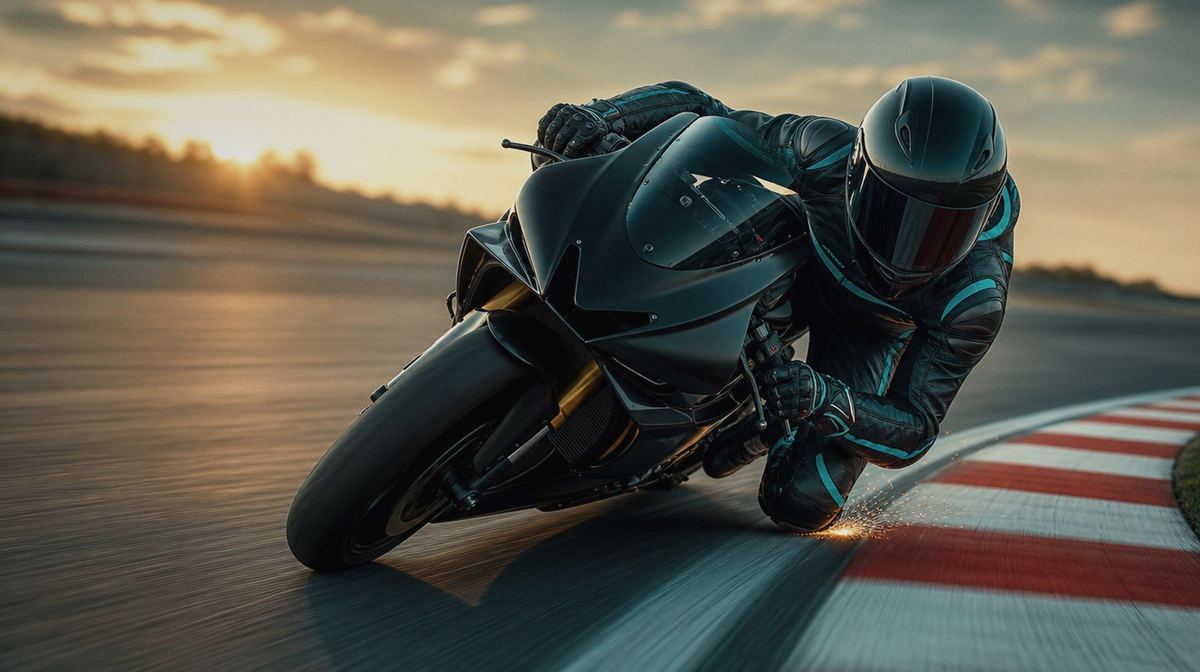
According to MotoGP.com, riders lean their bikes up to 65 degrees in corners1. Back in 2013 the FIM quoted 64 degrees and credited improvements in grip at the tire's shoulder2. In the ideal model, 64 degrees corresponds to tan 64° = 2.05 g of lateral acceleration.
Don't take that 2 g literally. Two effects from the section above pull in opposite directions: wide racing tires force the bike to lean further than the lateral acceleration alone would require, while a rider hanging far off the inside reduces the lean the bike needs. We found no official figure for lateral g in MotoGP, so we don't quote one.
The braking side is better documented. Brembo data for the Red Bull Ring puts peak deceleration at 1.5 g, with riders on the brakes for almost 29 seconds a lap; into Turn 4 they go from 301 to 81 km/h (187 to 50 mph) in 5.2 seconds over 246 metres (807 ft)5. That is an average deceleration of (301 − 81) / 3.6 / 5.2 = 11.8 m/s², or about 1.2 g across the whole braking zone (our arithmetic).
Key figuresMotoGP braking at the Red Bull Ring in numbers
- 1.5 gpeak deceleration (Brembo data) 5
- 1.2 gaverage deceleration into Turn 4, our arithmetic
- 29 salmost this long on the brakes per lap 5
Measuring your own lean: mount, alignment, venue
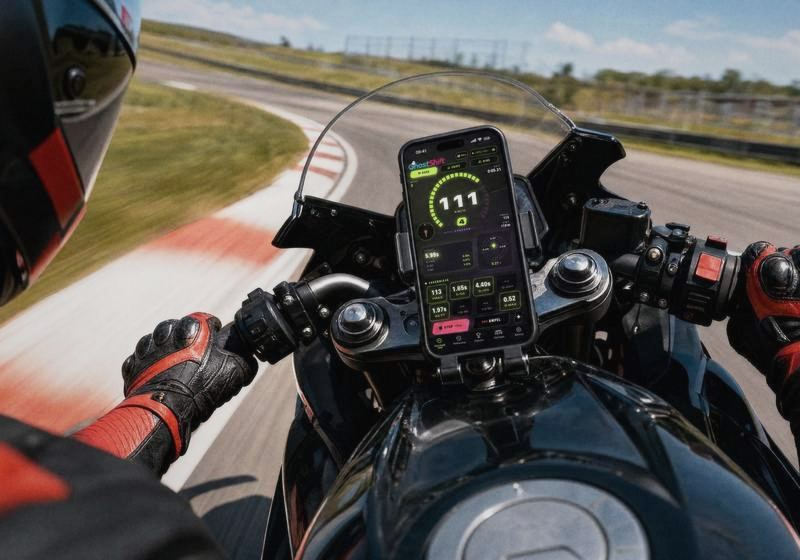
A phone can only show a meaningful lean angle if it is fixed to the motorcycle. In a tank bag or a jacket pocket it measures the bag or the rider, not the bike. These points help you get comparable numbers:
- Solid, centred mount. On the bars or the top yoke, square to the bike, with no play. More in our guide to phone mounts.
- Take vibration seriously. Apple advises against attaching an iPhone to motorcycles with high-power or high-volume engines, because intense vibration can degrade the camera's optical image stabilisation and autofocus. For lower-vibration vehicles Apple recommends a vibration-dampening mount6. Decide deliberately whether and how you mount your phone.
- Open sky. Speed and lap times need GPS reception, so no indoor halls and ideally no dense tree cover.
- Same conditions. Only compare numbers from the same mount, the same track and similar weather.
You learn most from comparison. If, with the phone mounted square, bike mode shows clearly more lean in left-handers than in right-handers of similar speed, you may have a favourite side worth working on with an instructor. To prepare for your first day on a circuit, see the track day checklist; for the basics of measuring with a phone, read the main guide. GhostShift's track features are on the track page.
FAQ
How far can a motorcycle lean on street tires?
An SAE study cites peak tire-to-asphalt friction of about 1.2 on dry roads, which works out to roughly 50 degrees in the simple model. On many bikes, though, footpegs or other parts touch down first: the study puts most motorcycles' ground-clearance limit between 25 and 50 degrees.
Does a heavier bike need more lean?
Not in the ideal model: mass cancels out, and only speed and radius matter. In practice tire width, centre-of-gravity height and the rider's body position shift the figure by a few degrees.
Why does my bike lean more than the formula says?
The formula assumes an infinitely thin tire. On a real, round tire the contact patch moves inward as you lean, so the bike has to lean further. Riding tests confirm that the basic formula usually underestimates the lean angle.
Can a phone measure lean angle?
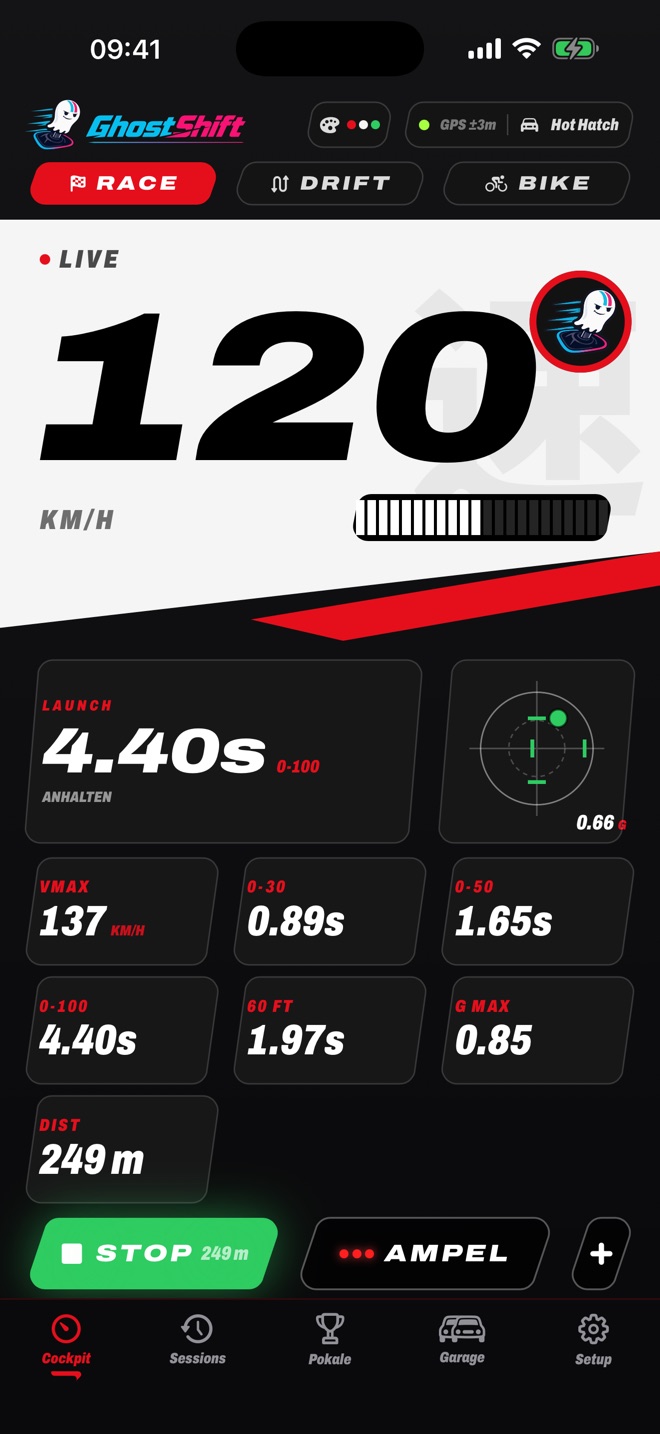
GhostShift's bike mode shows your lean angle in degrees, left and right separately. It's an estimate from the iPhone's sensors, not a calibrated instrument, and it only works with the phone solidly mounted to the bike.
Where can I try this safely?
On race tracks during track days or rider training, at kart tracks that run bike days for pit bikes or supermoto, and on other closed courses with the operator's permission. Never on public roads.
Sources
- How do MotoGP riders corner so fast? – MotoGP.com, 2 Sep 2026
- The lean angle experience – FIM, 27 Sep 2013
- Bicycle and motorcycle dynamics (section: Leaning) – Wikipedia
- Carter, Rose, Pentecost: Validation of Equations for Motorcycle and Rider Lean on a Curve – SAE Int. J. Trans. Safety 3(2), 2015
- Brembo data on MotoGP braking at the Red Bull Ring – Crash.net, 14 Aug 2025
- Exposure to vibrations, like those generated by high-powered motorcycle engines, might impact iPhone cameras – Apple Support
GhostShift is not a calibrated or certified instrument: every value is an estimate from your iPhone's sensors. Only do timed runs on a closed course with the operator's permission.