Short answer
Usually yes for combustion engines: cold, dry air is denser. At 29.92 inHg a cubic metre weighs 1.269 kg at 41 °F but 1.164 kg at 86 °F, over 8 % less. NA engines lose more in the heat than turbos. Our model puts 41 °F vs 86 °F at 0.23 to 0.46 s over 0-60 (NA engine).
Working out air density: pressure, temperature and humidity
Air is a gas, and its density follows the ideal gas law: more pressure makes it denser, more heat makes it thinner. For dry air:
ρ = p / (R · T), with p in pascals, T in kelvin and the gas constant for dry air R = 287.05 J/(kg·K)1.
In the standard atmosphere at sea level, 59 °F (15 °C) and 29.92 inHg (1013.25 hPa), that gives 1.225 kg/m³1. The same formulas work through typical conditions (own arithmetic, humidity via the Tetens formula for saturation vapour pressure1):
| Condition | Air density | vs standard (1.225) |
|---|---|---|
| 41 °F (5 °C), 29.92 inHg, dry | 1.269 kg/m³ | +3.6 % |
| 59 °F (15 °C), 29.92 inHg, dry (standard) | 1.225 kg/m³ | 0 |
| 68 °F (20 °C), 29.92 inHg, dry | 1.204 kg/m³ | −1.7 % |
| 86 °F (30 °C), 29.92 inHg, dry | 1.164 kg/m³ | −5.0 % |
| 86 °F (30 °C), 29.92 inHg, 80 % humidity | 1.150 kg/m³ (dry air 1.125) | −6.1 % (dry air −8.1 %) |
| 68 °F, 28.94 inHg (980 hPa, low pressure) | 1.165 kg/m³ | −4.9 % |
| 68 °F, 30.42 inHg (1030 hPa, high pressure) | 1.224 kg/m³ | −0.1 % |
| Track at 3,281 ft (1,000 m), 26.55 inHg, 59 °F | 1.087 kg/m³ | −11.3 % |

ChartThe warmer the air, the thinner: 8.3 % less at 86 °F than at 41 °F
- 29.92 inHg (standard)
- 28.94 inHg (low)
Values as a table
| Air temperature in °F | 29.92 inHg (standard) | 28.94 inHg (low) |
|---|---|---|
| 32 | 1.292 kg/m³ | 1.250 kg/m³ |
| 41 | 1.269 kg/m³ | 1.227 kg/m³ |
| 50 | 1.247 kg/m³ | 1.206 kg/m³ |
| 59 | 1.225 kg/m³ | 1.185 kg/m³ |
| 68 | 1.204 kg/m³ | 1.165 kg/m³ |
| 77 | 1.184 kg/m³ | 1.145 kg/m³ |
| 86 | 1.164 kg/m³ | 1.126 kg/m³ |
| 95 | 1.146 kg/m³ | 1.108 kg/m³ |
| 104 | 1.127 kg/m³ | 1.090 kg/m³ |
Between a cool 41 °F morning and a hot 86 °F afternoon at the same pressure, the ratio is 1.164 / 1.269 = 0.917, so 8.3 % less air in every litre the engine breathes.
Humidity often gets read the wrong way round. Humid air is lighter than dry air, because a water molecule (molecular weight 18) is lighter than the nitrogen and oxygen molecules it displaces1. What matters to an engine is the dry-air share, because that is where the oxygen is. At 86 °F the saturation vapour pressure is 42.4 hPa. At 80 % humidity that is 33.9 hPa of water vapour, leaving 1013.25 − 33.9 = 979.4 hPa for the dry air. That is why power-correction standards work with dry-air pressure, total pressure minus vapour pressure8.
Density altitude: the weather expressed in feet
Density altitude rolls pressure, temperature and humidity into one number. It is the altitude in the standard atmosphere at which the air would have the same density as the air where you are1. Pilots define it as pressure altitude corrected for non-standard temperature2. High temperature, low pressure, high elevation and high humidity all push density altitude up2.
Converted through the standard atmosphere (own arithmetic):
- 86 °F, 29.92 inHg, dry: density altitude about +1,735 ft (+530 m)
- 41 °F, 29.92 inHg, dry: density altitude about −1,210 ft (−370 m)
To the engine, a summer afternoon at sea level feels like an autumn morning almost 3,000 ft higher. Density altitude is handy because it puts effects you would otherwise treat separately on one scale: a 30.42 inHg high offsets part of the summer heat, a low makes it worse.
Naturally aspirated vs turbo: who loses how much
A naturally aspirated engine loses power almost in step with air density, a turbo engine much less. For NA engines the sources give rules of thumb, but they don't agree:
- By density altitude: about 3 % of power per 1,000 ft, according to turbocharger maker Garrett3. The aviation rule of thumb is 3.5 % per 1,000 ft of density altitude2.
- By temperature: about 1 % of power per 10 °F of warmer air, according to a drag-racing site4.
Applied to 41 °F vs 86 °F, a 45 °F gap and about 2,950 ft of density altitude, the rules give different answers:
| Rule of thumb | Arithmetic | NA power loss |
|---|---|---|
| 3 % per 1,000 ft density altitude3 | 2.95 × 3 % | about 9 % |
| 3.5 % per 1,000 ft density altitude2 | 2.95 × 3.5 % | about 10 % |
| 1 % per 10 °F4 | 4.5 × 1 % | about 4.5 % |
Chart41 °F vs 86 °F: the rules of thumb say 4.5 to 10 % less power
Values as a table
| NA engine, rule of thumb | |
|---|---|
| 3.5 % per 1,000 ft density altitude (aviation) | 10.3% |
| 3 % per 1,000 ft density altitude (turbo maker) | 8.9% |
| Power proportional to air density | 8.3% |
| 1 % per 10 °F warmer (drag racing) | 4.5% |
That is, frankly, a wide spread. The density-altitude rules come from aviation and high-altitude operation and effectively assume power proportional to air density. The temperature rule is a drag-racing rule of thumb from experience. Which one fits a particular car only your own runs can show.
Turbos are different. Garrett explains that in thinner air the engine computer adjusts boost and other parameters to hold the same power, as long as the turbo can supply the extra airflow and shaft speed3. A turbo engine therefore loses much less, how much depends on how much headroom the turbo has. In an EV no engine breathes at all, so air density only acts through drag. More in EV acceleration explained.
What it means for 0-60: a worked model
Between 41 °F and 86 °F, an NA engine loses about a quarter to half a second over 0-60 mph, a fully compensating turbo almost nothing. That comes from the same simple model car as in slope and wind: 1,500 kg (3,307 lb), 100 kW (134 hp) at the wheels at 41 °F, a 0.6 g traction limit, a drag area of 0.74 m²9. In the model, air density acts twice, on engine power and on drag.
| Condition | 0-60 mph | Difference |
|---|---|---|
| 41 °F, dry (baseline) | 6.79 s | – |
| 86 °F, NA, power proportional to density (−8.3 %) | 7.25 s | +0.46 s |
| 86 °F, NA, power by the temperature rule (−4.5 %) | 7.02 s | +0.23 s |
| 86 °F, turbo with full compensation | 6.77 s | −0.02 s |
Own model calculation, not a measurement. The turbo car is even a hair quicker in the model because thinner air drags less. Real cars add effects the model leaves out, such as hotter charge air. The launch is traction-limited in the model and barely reacts to weather, so the loss builds up higher in the speed range.
Key figuresModel car, 0-60 mph: 86 °F instead of 41 °F
- +0.46 sNA engine, power proportional to density, own model calculation
- +0.23 sNA engine by the temperature rule, own model calculation
- −0.02 sTurbo with full compensation, own model calculation
For the quarter mile the sources diverge even further. Drag Coverage puts the cost of each 1,000 ft of density altitude at about 0.02 s for a big, fast car and up to 0.15 s for a slow junior dragster4. A correction table published as coming from the NHRA multiplies the time at 2,000 ft by 0.9770 and at 5,000 ft by 0.93805. For a car running 13.00 s at 2,000 ft that gives 12.70 s at sea level, 0.30 s, while the big-car rule of thumb would say only 0.04 s. Both are approximations, and there is no universal number.
Why SAE J1349 corrects dyno power, not acceleration times
SAE J1349 is a standard for engine power on a dyno, not for elapsed times. It sets a basis for rating net engine power, reference conditions for inlet air and fuel, a method for correcting observed power to those reference conditions, and the procedure for measuring it on a dynamometer6. The reference conditions are 77 °F (25 °C), 99 kPa (29.23 inHg) and 0 % humidity7. The correction is meant for air temperatures from 15 to 35 °C (59–95 °F) and dry-air pressures from 900 to 1,050 mbar8.
A 0-60 time can't be converted cleanly with it, for three reasons:
- The launch depends on traction: as long as the tires set the limit, more power changes little.
- Drag changes too: thinner air costs power but also holds the car back less.
- A car is more than an engine: tire and track temperature, gearbox and shift points react to the weather, but not according to the formula.
So scaling an elapsed time to standard weather is always an estimate. More on why measured times differ from brochure figures in why your 0-60 doesn't match the brochure.
In practice: log the weather so runs stay comparable
Rather than converting times, it is cleaner to compare runs only under similar conditions. That takes a few notes per session:
- Air temperature in the shade, not the car's display after it has sat in the sun.
- Actual local pressure: weather services and airports often report a value corrected to sea level. For air density you need the actual pressure where you are, and the two can differ considerably1.
- Relative humidity, especially on muggy summer days.
- Work out density altitude or air density and compare runs only within a similar band, as our own guide value about ±1,000 ft of density altitude, which by the 3 % rule is roughly 3 % of NA power.
- Same session, same conditions: a before-and-after comparison, say around a change to the car, is most telling on the same day, runs close together.
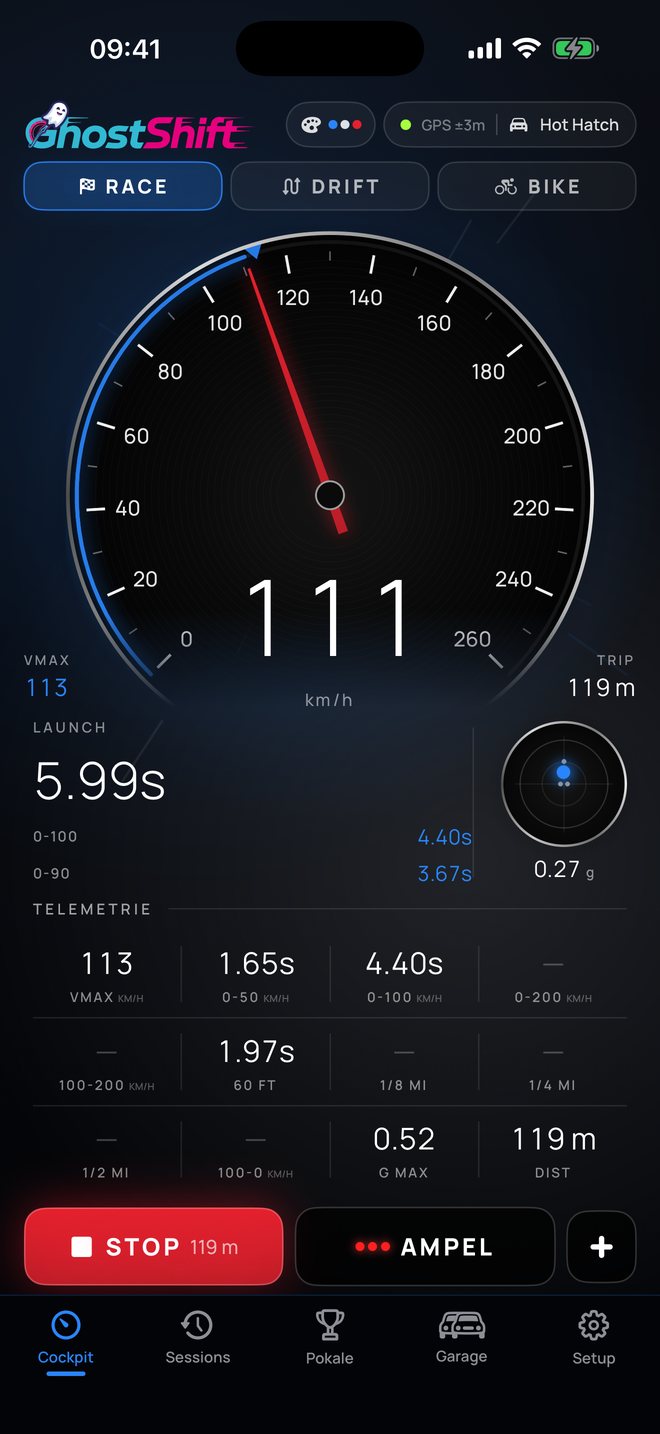
Times measured with a phone are estimates from GPS and motion sensors, not a calibrated instrument. That is exactly why clean comparisons pay off: when strip, mount, slope and air density are the same, a difference in time really does show a change in the car or in your launch. The full routine for a timed run is in the guide to measuring 0-60 with your phone, and every discipline on the measure page.
FAQ
How much quicker is a car in cold weather?
A combustion-engined car gets more oxygen per intake stroke in cold air and makes more power, especially without a turbo. How much time that is worth depends on the car. In this article's model, 41 °F vs 86 °F is worth about 0.23 to 0.46 s over 0-60 mph.
What is density altitude?
The altitude in the standard atmosphere at which the air would be as dense as the air where you are. It rolls temperature, pressure and humidity into one number. 86 °F at sea level works out to about 1,735 ft of density altitude.
Are turbo cars faster in cold weather?
They gain less than naturally aspirated cars, because they lose less in the heat. According to turbocharger maker Garrett, the engine computer raises boost to hold power in thinner air, as long as the turbo can supply the extra airflow and shaft speed.
Does humidity make a car slower?
Slightly. Humid air is lighter than dry air, and water vapour displaces oxygen. At 86 °F and 80 % relative humidity, the dry-air share the engine can burn is about 3 % lower than in dry air.
Can I correct 0-60 times with SAE J1349?
Not meaningfully. SAE J1349 corrects engine power measured on a dyno to reference conditions. An acceleration time also depends on traction, drag, gear changes and tires, which don't change in the same proportion.
Sources
- Air density and density altitude – Richard Shelquist, wahiduddin.net
- Density Altitude and You – Leo Berube, AVweb, 4 Sep 2020
- How to turbocharge at elevation: counteracting lower air density – Garrett Motion, 15 Aug 2019
- Racing the Air: How Weather, Density Altitude, and Atmospheric Changes Decide Rounds – Kline Whitley, Drag Coverage, updated 6 Jan 2026
- Quarter mile correction factors (table credited to the NHRA) – Corvette Action Center
- SAE J1349 Engine Power Test Code, summary – Swiss Association for Standardization (SNV)
- The ambient correction factors (SAE J1349, SAE J607) – DDI Software Tech Corner
- Engine horsepower correction factor – Richard Shelquist, wahiduddin.net
- Automobile drag coefficient – Wikipedia
GhostShift is not a calibrated or certified instrument: every value is an estimate from your iPhone's sensors. Only do timed runs on a closed course with the operator's permission.